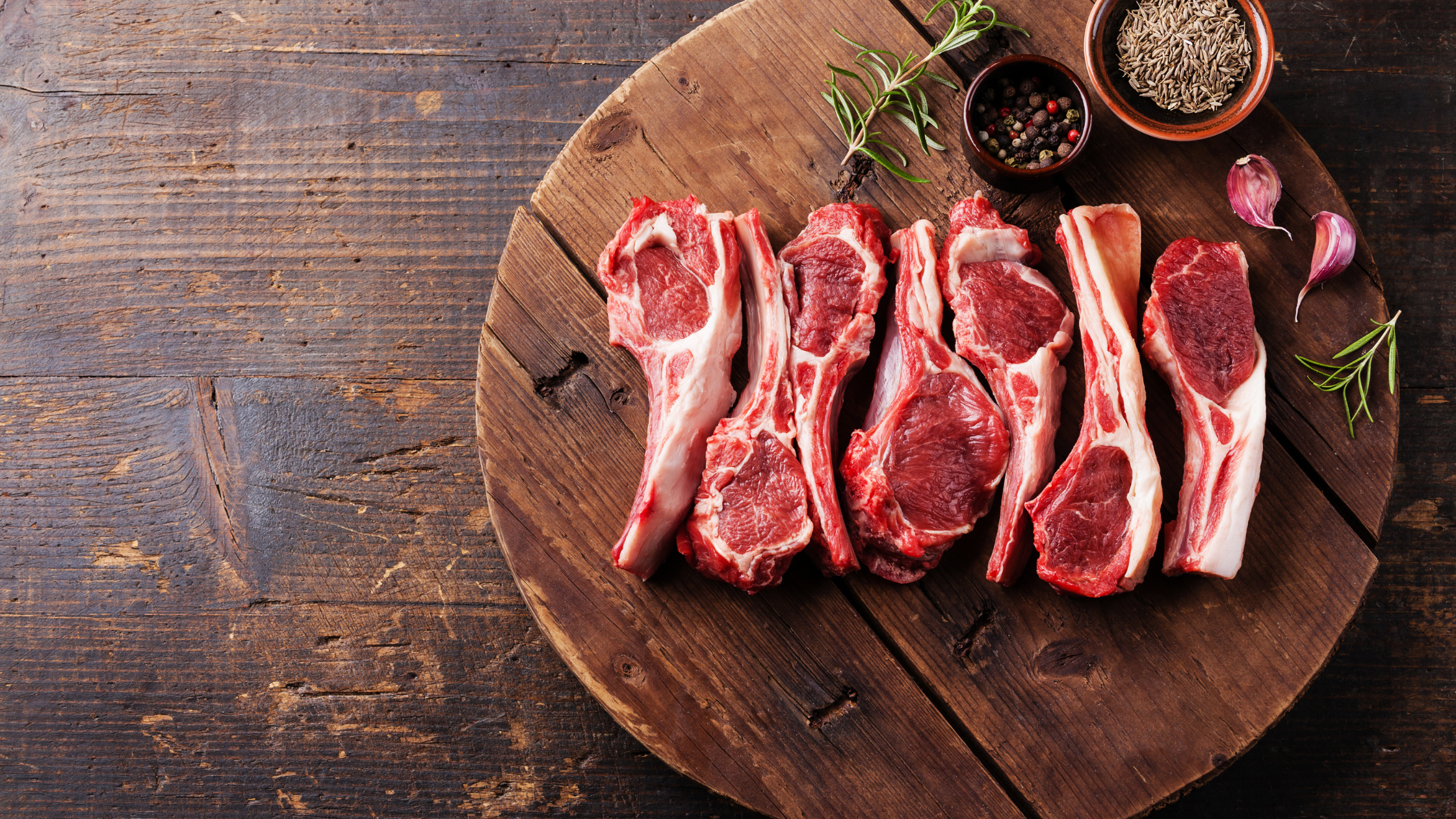
Lamb
Lamb, the succulent meat derived from young sheep, has been a staple in cuisines around the world for centuries. Loved for its tender texture and distinctive flavor, lamb holds a significant place in both Eastern and Western culinary traditions. Beyond its culinary appeal, lamb also boasts an array of health benefits and therapeutic properties.
[/et_pb_text][et_pb_heading title=”History” _builder_version=”4.27.4″ _module_preset=”default” title_level=”h2″ title_text_color=”#000000″ custom_margin=”||10px||false|false” global_colors_info=”{}”][/et_pb_heading][et_pb_text _builder_version=”4.27.4″ _module_preset=”default” text_text_color=”#000000″ text_font_size=”17px” global_colors_info=”{}”]The consumption of lamb traces back thousands of years, with evidence of its presence in various ancient civilizations. In the Middle East, sheep domestication began around 9,000-11,000 years ago, and lamb became a primary source of sustenance for pastoral communities. Ancient Greek and Roman cultures also revered lamb, incorporating it into their feasts and religious rituals.
[/et_pb_text][et_pb_heading title=”Health Benefits” _builder_version=”4.27.4″ _module_preset=”default” title_level=”h2″ title_text_color=”#000000″ custom_margin=”||10px||false|false” custom_padding=”||||false|false” global_colors_info=”{}”][/et_pb_heading][et_pb_text _builder_version=”4.27.4″ _module_preset=”default” text_text_color=”#000000″ text_font_size=”17px” global_colors_info=”{}”]Lamb is a nutrient-dense food that is rich in high-quality protein, essential amino acids, vitamins, and minerals, making it an excellent choice for promoting overall health and well-being. The protein content in lamb supports muscle growth and repair, making it particularly beneficial for athletes and individuals aiming to build lean muscle mass. Additionally, lamb is a significant source of heme iron, which is highly bioavailable and plays a crucial role in red blood cell production and oxygen transport throughout the body. The abundance of zinc in lamb contributes to immune function, wound healing, and DNA synthesis, while its B vitamin content, including B12, B6, and niacin, is vital for energy metabolism, nervous system function, and cardiovascular health. Overall, the combination of these nutrients underscores lamb’s role as a valuable addition to a balanced diet.
[/et_pb_text][/et_pb_column][/et_pb_row][/et_pb_section][et_pb_section fb_built=”1″ _builder_version=”4.27.4″ _module_preset=”default” background_color=”#F2F2F2″ custom_padding=”30px||4px||false|false” global_colors_info=”{}”][et_pb_row column_structure=”2_3,1_3″ _builder_version=”4.27.4″ _module_preset=”default” custom_margin=”-24px|auto||auto||” custom_padding=”4px||9px|||” global_colors_info=”{}”][et_pb_column type=”2_3″ _builder_version=”4.27.4″ _module_preset=”default” global_colors_info=”{}”][et_pb_heading title=”Best Preparation Methods ” _builder_version=”4.27.4″ _module_preset=”default” custom_margin=”||10px||false|false” global_colors_info=”{}”][/et_pb_heading][et_pb_text _builder_version=”4.27.4″ _module_preset=”default” text_text_color=”#000000″ text_font_size=”17px” global_colors_info=”{}”]Lamb is a cherished ingredient in various culinary traditions, celebrated for its rich flavor and versatility. In Eastern cuisines, it is often featured in dishes such as Indian curry, Middle Eastern kebabs, and Central Asian pilafs, where it is typically enhanced with aromatic spices and slow-cooking techniques that deepen its flavor profile. In contrast, Western cuisines highlight lamb in preparations like Greek moussaka, French rack of lamb, and British shepherd’s pie, often pairing it with herbs such as rosemary, thyme, and mint to accentuate its natural richness.
[/et_pb_text][et_pb_image src=”https://www.immortalme.com/wp-content/uploads/2025/02/Screenshot-2025-02-14-203339.png” title_text=”Screenshot 2025-02-14 203339″ _builder_version=”4.27.4″ _module_preset=”default” border_radii=”on|6px|6px|6px|6px” box_shadow_style=”preset2″ global_colors_info=”{}”][/et_pb_image][/et_pb_column][et_pb_column type=”1_3″ _builder_version=”4.27.4″ _module_preset=”default” global_colors_info=”{}”][et_pb_image src=”https://www.immortalme.com/wp-content/uploads/2025/01/Lamb.png” title_text=”Lamb” _builder_version=”4.27.4″ _module_preset=”default” border_radii=”on|6px|6px|6px|6px” box_shadow_style=”preset1″ box_shadow_color=”#84776C” global_colors_info=”{}”][/et_pb_image][/et_pb_column][/et_pb_row][/et_pb_section][et_pb_section fb_built=”1″ _builder_version=”4.27.4″ _module_preset=”default” background_color=”#F2F2F2″ custom_padding=”29px||1px|||” global_colors_info=”{}”][et_pb_row _builder_version=”4.27.4″ _module_preset=”default” custom_margin=”-12px|auto||auto||” custom_padding=”4px|||||” global_colors_info=”{}”][et_pb_column type=”4_4″ _builder_version=”4.27.4″ _module_preset=”default” global_colors_info=”{}”][et_pb_heading title=”Precautions and Possible Side Effects” _builder_version=”4.27.4″ _module_preset=”default” title_level=”h2″ title_text_color=”#000000″ custom_margin=”||10px||false|false” global_colors_info=”{}”][/et_pb_heading][et_pb_text _builder_version=”4.27.4″ _module_preset=”default” text_text_color=”#000000″ text_font_size=”17px” global_colors_info=”{}”]While lamb provides numerous health benefits, individuals with specific dietary restrictions or health conditions should exercise caution when including it in their diets. Due to its high saturated fat content, those with high cholesterol or cardiovascular issues may need to limit their intake of lamb to mitigate potential health risks. Additionally, some individuals may have allergies to lamb meat, necessitating its avoidance. Religious or cultural beliefs may also restrict the consumption of lamb for certain groups. Although lamb is generally safe for consumption, excessive intake of saturated fat and cholesterol can contribute to cardiovascular problems, including heart disease. Furthermore, individuals with allergies to red meat should refrain from consuming lamb to prevent allergic reactions. While lamb does not typically interact with medications, those taking iron supplements should monitor their iron intake from lamb to avoid excessive iron levels in the body.
[/et_pb_text][/et_pb_column][/et_pb_row][/et_pb_section][et_pb_section fb_built=”1″ admin_label=”Post Body” _builder_version=”4.27.4″ background_color=”#F2F2F2″ custom_padding=”28px||3px|||” locked=”off” global_colors_info=”{}”][et_pb_row column_structure=”1_2,1_2″ _builder_version=”4.27.4″ custom_margin=”-28px|auto||auto||” custom_padding=”3px||10px|||” locked=”off” global_colors_info=”{}”][et_pb_column type=”1_2″ _builder_version=”4.16″ global_colors_info=”{}”][et_pb_heading title=”Eastern and Western Nutrition” _builder_version=”4.27.4″ _module_preset=”default” custom_margin=”||10px||false|false” hover_enabled=”0″ global_colors_info=”{}” title_level=”h2″ title_text_color=”#000000″ sticky_enabled=”0″][/et_pb_heading][et_pb_text _builder_version=”4.27.4″ _module_preset=”default” text_text_color=”#000000″ text_font_size=”17px” global_colors_info=”{}”]Lamb is a versatile ingredient featured prominently in both Eastern and Western cuisines, each showcasing its unique flavors and culinary traditions. In traditional Chinese medicine (TCM), lamb is associated with the Spleen and Stomach meridians, believed to possess warming properties that nourish these organs, thereby promoting digestion and energy production within the body.
[/et_pb_text][/et_pb_column][et_pb_column type=”1_2″ _builder_version=”4.16″ global_colors_info=”{}”][et_pb_image src=”https://www.immortalme.com/wp-content/uploads/2025/02/Screenshot-2025-02-15-002842.png” title_text=”Screenshot 2025-02-15 002842″ _builder_version=”4.27.4″ _module_preset=”default” hover_enabled=”0″ border_radii=”on|6px|6px|6px|6px” box_shadow_style=”preset1″ global_colors_info=”{}” sticky_enabled=”0″ box_shadow_spread=”3px” box_shadow_color=”#84776C”][/et_pb_image][/et_pb_column][/et_pb_row][/et_pb_section][et_pb_section fb_built=”1″ _builder_version=”4.27.4″ _module_preset=”default” background_color=”#F2F2F2″ custom_padding=”28px||5px|||” global_colors_info=”{}”][et_pb_row _builder_version=”4.27.4″ _module_preset=”default” custom_padding=”4px||3px|||” global_colors_info=”{}”][et_pb_column type=”4_4″ _builder_version=”4.27.4″ _module_preset=”default” global_colors_info=”{}”][et_pb_heading title=”Final Thoughts” _builder_version=”4.27.4″ _module_preset=”default” title_level=”h2″ title_text_color=”#000000″ custom_margin=”||10px||false|false” global_colors_info=”{}”][/et_pb_heading][et_pb_text _builder_version=”4.27.4″ _module_preset=”default” text_text_color=”#000000″ text_font_size=”17px” global_colors_info=”{}”]Lamb’s rich history, nutritional profile, and health benefits make it a valuable addition to any diet. Whether enjoyed in traditional Eastern dishes or contemporary Western cuisine, lamb offers versatility and flavor while providing essential nutrients to support overall health and well-being.
[/et_pb_text][/et_pb_column][/et_pb_row][et_pb_row _builder_version=”4.27.4″ _module_preset=”default” custom_padding=”42px||5px|||” global_colors_info=”{}”][et_pb_column type=”4_4″ _builder_version=”4.27.4″ _module_preset=”default” global_colors_info=”{}”][et_pb_divider color=”#84776C” divider_weight=”2px” _builder_version=”4.27.4″ _module_preset=”default” global_colors_info=”{}”][/et_pb_divider][et_pb_toggle title=”References” open_toggle_background_color=”#FFFFFF” closed_toggle_background_color=”#FFFFFF” icon_color=”#84776C” toggle_icon=”||fa||900″ use_icon_font_size=”on” icon_font_size=”25px” open_icon_color=”#E02B20″ open_toggle_icon=”||fa||900″ open_use_icon_font_size=”on” open_icon_font_size=”25px” _builder_version=”4.27.4″ _module_preset=”default” title_text_color=”#000000″ title_font=”Cormorant Garamond||||||||” title_text_align=”left” title_font_size=”20px” body_line_height=”1.5em” text_orientation=”left” custom_margin=”||42px|||” custom_padding=”|||20px|false|false” border_radii=”on|6px|6px|6px|6px” box_shadow_style=”preset1″ box_shadow_color=”#84776C” global_colors_info=”{}”]Andrés, S., Valdés, C., Santos, A., Mateo, J., & Giráldez, F. (2020). Effects of birth weight on animal performance, fattening traits and meat quality of lambs. Animals, 10(12), 2364. https://doi.org/10.3390/ani10122364
Annett, R., Carson, A., Fearon, A., & Kilpatrick, D. (2011). Effects of supplementation with fish oil and barium selenate on performance, carcass characteristics and muscle fatty acid composition of late season lamb finished on grass-based or concentrate-based diets. Animal, 5(12), 1923-1937. https://doi.org/10.1017/s1751731111000966
Carrasco, C., González-Mateos, A., Gómez, M., & Rodríguez, A. (2022). Evidence on the potential effects of halal meat on sleep/wake cycles and mood state profile: a pilot study. International Food Research Journal, 29(3), 510-519. https://doi.org/10.47836/ifrj.29.3.04
Choi, M., Abduzukhurov, T., Park, D., Kim, E., & Hong, G. (2018). Effects of deep freezing temperature for long-term storage on quality
characteristics and freshness of lamb meat. Korean Journal for Food Science of Animal Resources, 38(5), 959-969. https://doi.org/10.5851/kosfa.2018.e28
Ciliberti, M., Santillo, A., Marino, R., Ciani, E., Caroprese, M., Rillo, L., … & Albenzio, M. (2021). Lamb meat quality and carcass evaluation of five autochthonous sheep breeds: towards biodiversity protection. Animals, 11(11), 3222. https://doi.org/10.3390/ani11113222
Fernandes, S., Monteiro, A., Dittrich, R., Salgado, J., Silva, C., Silva, M., … & Pinto, P. (2012). Early weaning and concentrate supplementation on the performance and metabolic profile of grazing lambs. Revista Brasileira De Zootecnia, 41(5), 1292-1300. https://doi.org/10.1590/s1516-35982012000500029
Gallardo, B., Gómez‐Cortés, P., Mantecón, Á., Juárez, M., Manso, T., & Fuente, M. (2014). Effects of olive and fish oil ca soaps in ewe diets on milk fat and muscle and subcutaneous tissue fatty-acid profiles of suckling lambs. Animal, 8(7), 1178-1190. https://doi.org/10.1017/s1751731114000238
Guo, Y., Zhao, X., Ming, L., Zhang, C., Zhang, Y., Ma, Q., … & Luo, H. (2021). Using fecal dna metabarcoding to investigate foraging reveals the effects of specific herbage on the improved n-3 fatty acid (pufa) composition in the longissimus dorsi muscle of grazing tan sheep. Journal of Agricultural and Food Chemistry, 69(33), 9725-9734. https://doi.org/10.1021/acs.jafc.1c03788
Guy, F., Prache, S., Thomas, A., Bauchart, D., & Andueza, D. (2011). Prediction of lamb meat fatty acid composition using near-infrared reflectance spectroscopy (nirs). Food Chemistry, 127(3), 1280-1286. https://doi.org/10.1016/j.foodchem.2011.01.084
Gómez‐Cortés, P., Galisteo, O., Avilés, C., Blanco, F., Fuente, M., Sánchez, N., … & Marín, A. (2019). Intramuscular fatty acid profile of feedlot lambs fed concentrates with alternative ingredients. Animal Production Science, 59(5), 914. https://doi.org/10.1071/an17885
Haro, A., Evan, T., Vázquez, J., Díaz, M., Cano, J., & Carro, M. (2020). Effect of a diet supplemented with malic acid–heat (mah) treated sunflower on carcass characteristics, meat composition and fatty acids profile in growing lambs. Animals, 10(3), 487. https://doi.org/10.3390/ani10030487
Issakowicz, J., Issakowicz, A., Bueno, M., Costa, R., Geraldo, A., Abdalla, A., … & Louvandini, H. (2018). Crossbreeding locally adapted hair sheep to improve productivity and meat quality. Scientia Agricola, 75(4), 288-295. https://doi.org/10.1590/1678-992x-2016-0505
Le, H., Nguyen, Q., Nguyen, D., Malau-Aduli, B., Nichols, P., & Malau-Aduli, A. (2018). Enhanced omega-3 polyunsaturated fatty acid contents in muscle and edible organs of australian prime lambs grazing lucerne and cocksfoot pastures.. https://doi.org/10.20944/preprints201811.0097.v1
Lima, A., Oliveira, R., Silva, T., Barbosa, A., Nascimento, T., Oliveira, V., … & Bezerra, L. (2018). Feeding sunflower cake from biodiesel production to santa ines lambs: physicochemical composition, fatty acid profile and sensory attributes of meat. Plos One, 13(1), e0188648. https://doi.org/10.1371/journal.pone.0188648
Masters, D., Blache, D., Lockwood, A., Maloney, S., Norman, H., Refshauge, G., … & Hancock, S. (2023). Shelter and shade for grazing sheep: implications for animal welfare and production and for landscape health. Animal Production Science, 63(7), 623-644. https://doi.org/10.1071/an22225
Mulvihill, B. (2001). Ruminant meat as a source of conjugated linoleic acid (cla). Nutrition Bulletin, 26(4), 295-299. https://doi.org/10.1046/j.1467-3010.2001.00179.x
Nguyen, D., Malau‐Aduli, B., Cavalieri, J., Nichols, P., & Malau‐Aduli, A. (2018). Supplementation with plant-derived oils rich in omega-3 polyunsaturated fatty acids for lamb production. Veterinary and Animal Science, 6, 29-40. https://doi.org/10.1016/j.vas.2018.08.001
Peña-Avelino, L., Pinos-Rodríguez, J., Vicente, J., García-López, J., Yáñez, L., & Grajales, A. (2017). Effects of prosopis laevigata pods on carcass characteristics, non-carcass components, meat quality, fatty acid profile and sensory attributes. South African Journal of Animal Science, 47(6), 785. https://doi.org/10.4314/sajas.v47i6.6
Thompson, A., Ferguson, M., Gordon, D., Kearney, G., Oldham, C., & Paganoni, B. (2011). Improving the nutrition of merino ewes during pregnancy increases the fleece weight and reduces the fibre diameter of their progeny’s wool during their lifetime and these effects can be predicted from the ewe’s liveweight profile. Animal Production Science, 51(9), 794. https://doi.org/10.1071/an10161
Tánori-Lozano, A., Quintana-Romandía, A., Montalvo-Corral, M., Pinelli‐Saavedra, A., Valenzuela‐Melendres, M., Dávila-Ramírez, J., … & González‐Ríos, H. (2022). Influence of ferulic acid and clinoptilolite supplementation on growth performance, carcass, meat quality, and fatty acid profile of finished lambs. Journal of Animal Science and Technology, 64(2), 274-290. https://doi.org/10.5187/jast.2022.e21
Young, J., Thompson, A., Curnow, M., & Oldham, C. (2011). Whole-farm profit and the optimum maternal liveweight profile of merino ewe flocks lambing in winter and spring are influenced by the effects of ewe nutrition on the progeny’s survival and lifetime wool production. Animal Production Science, 51(9), 821. https://doi.org/10.1071/an10078
MyFoodData. (n.d.). *Nutrition facts for lamb, ground, cooked, lean and fat*. Retrieved December 17, 2024, from https://tools.myfooddata.com/nutrition-facts/174370/wt1/1
[/et_pb_toggle][/et_pb_column][/et_pb_row][/et_pb_section][et_pb_section fb_built=”1″ _builder_version=”4.27.4″ _module_preset=”default” background_color=”#84776C” custom_margin=”||-60px||false|false” custom_padding=”35px||60px||false|false” global_colors_info=”{}”][et_pb_row _builder_version=”4.27.4″ _module_preset=”default” custom_padding=”11px|||||” global_colors_info=”{}”][et_pb_column type=”4_4″ _builder_version=”4.27.4″ _module_preset=”default” global_colors_info=”{}”][et_pb_heading title=”More Articles You May Like” _builder_version=”4.27.4″ _module_preset=”default” title_text_color=”#FFFFFF” global_colors_info=”{}”][/et_pb_heading][et_pb_divider color=”#F2F2F2″ divider_weight=”2px” _builder_version=”4.27.4″ _module_preset=”default” global_colors_info=”{}”][/et_pb_divider][et_pb_blog_extras posts_number=”12″ include_categories=”57,19,56″ blog_layout=”slider” slider_layout=”vertical_grid” excerpt_length=”600″ show_author=”off” show_date=”off” category_color=”#2533ab” category_background_color=”RGBA(255,255,255,0)” show_comments=”off” content_color=”#000000″ slider_loop=”on” _builder_version=”4.27.4″ _module_preset=”default” header_text_color=”#000000″ body_text_color=”#000000″ meta_text_color=”#000000″ border_radii=”on|10px|10px|10px|10px” border_width_all=”2px” border_color_all=”rgba(242,242,242,0.32)” box_shadow_style=”preset2″ box_shadow_blur=”28px” box_shadow_color=”rgba(0,0,0,0.53)” global_colors_info=”{}”][/et_pb_blog_extras][/et_pb_column][/et_pb_row][et_pb_row _builder_version=”4.27.4″ _module_preset=”default” background_color=”#FFFFFF” border_radii=”on|6px|6px|6px|6px” global_colors_info=”{}”][et_pb_column type=”4_4″ _builder_version=”4.27.4″ _module_preset=”default” global_colors_info=”{}”][et_pb_text _builder_version=”4.27.4″ _module_preset=”default” text_text_color=”#84776C” text_font_size=”12px” text_line_height=”1.5em” header_font=”|300|||||||” header_font_size=”25px” header_4_font=”–et_global_heading_font||||||||” header_4_text_color=”#84776C” custom_padding=”|17px||17px|false|false” global_colors_info=”{}”]Medical Disclaimer
The information provided in this document is intended for educational and informational purposes only and should not be construed as medical advice, diagnosis, or treatment. It is essential to consult a qualified healthcare professional for any medical concerns or conditions. The content herein does not substitute for professional medical advice, and individuals should not disregard or delay seeking medical advice based on the information provided.
The authors and publishers of this document do not assume any responsibility for any adverse effects or consequences resulting from the use or application of the information contained herein. The reader is encouraged to conduct their own research and consult with healthcare providers to make informed decisions regarding their health and treatment options. Furthermore, the information presented may not reflect the most current research or medical guidelines, as medical knowledge is continually evolving. Therefore, it is imperative to verify the information with up-to-date, peer-reviewed sources and consult with medical professionals for personalized advice.
[/et_pb_text][/et_pb_column][/et_pb_row][/et_pb_section]